
- February 16, 2026
- admin
- 0
EDR vs. Traditional Antivirus: The Difference That Determines Security Today
Cybersecurity in modern organizations has changed dramatically in recent years. Threats have become more advanced, more automated, and increasingly focused on exploiting human error or vulnerabilities in legitimate software. In this context, the question arises more often than ever: Is a traditional antivirus still enough?
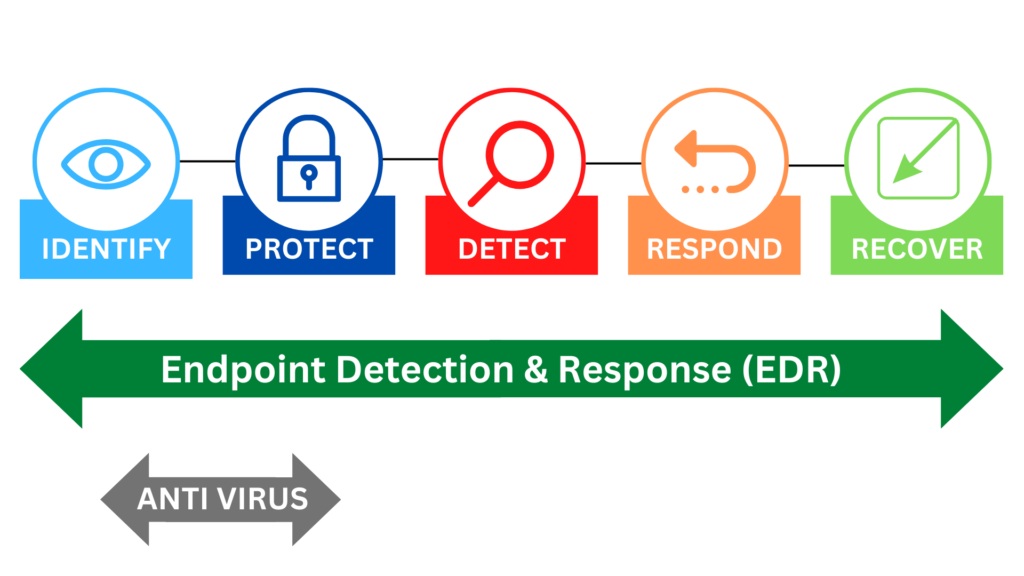
The short answer is no. This is why organizations are shifting to EDR (Endpoint Detection and Response) solutions, which are significantly more advanced and far more effective.
What Is a Traditional Antivirus?
A traditional antivirus (AV) is a security solution that relies primarily on signatures and the detection of known patterns of malicious code. Its main purpose is to:
- detect known viruses, trojans, and worms,
- block basic forms of malicious files,
- prevent infection through files and websites.
A typical antivirus operates reactively. This means it can recognize a threat only if it has already been analyzed and a signature has been created for it. Against new or unknown attacks (so‑called zero‑day attacks), antivirus solutions are often ineffective.
What Is EDR (Endpoint Detection and Response)?
EDR is an advanced security technology focused on actively monitoring, analyzing, and responding to suspicious behavior on endpoints (computers, servers, laptops).
EDR includes:
- machine learning and behavioral analysis,
- deep telemetry (processes, network traffic, registry changes, etc.),
- real‑time attack detection,
- immediate response options (device isolation, process termination, file restoration),
- forensic analysis,
- a complete view of the attack chain.
While antivirus attempts to identify malicious files, EDR examines the entire context. This allows it to detect attacks that involve no traditional malware — such as fileless attacks, abuse of legitimate tools (e.g., PowerShell), or other unknown exploitation techniques.
Key Differences Between EDR and Antivirus
Detection Method
- AV relies on signature-based detection and is effective only against known threats.
- EDR uses behavioral analysis, machine learning, and event correlation, detecting attacks even when they are not yet classified.
Visibility
- AV sees individual files and isolated events.
- EDR monitors the full activity of the device — processes, network communication, access patterns, and system changes.
Response
- AV can block or delete a threat.
- EDR can:
- isolate a device,
- stop malicious processes,
- remove persistence mechanisms,
- restore the system to a pre‑attack state.
Forensic Capabilities
- AV generally cannot provide insight into what happened before, during, or after an attack.
- EDR stores event data and enables full attack-chain analysis.
Fileless Attacks
- AV is nearly blind to attacks that do not use malicious files.
- EDR detects them based on unusual process behavior or suspicious commands.
Why EDR Is Better for Modern Businesses
Modern attacks are too complex for traditional antivirus
Today’s attacks use combinations of techniques: social engineering, malicious macros, PowerShell scripts, injection into legitimate processes, and more. These attacks often do not involve files that antivirus software can inspect.
EDR detects changes in system behavior — even when no file is involved.
Faster, automated response prevents the spread of infection
Once an attacker gains initial access, they rarely stop there — they begin moving laterally across the network. Antivirus alone cannot prevent this.
EDR can:
- isolate compromised devices,
- block attacker processes,
- stop lateral movement,
- restore the system to a safe state,
- alert the security team instantly.
This prevents a single infected device from becoming a full-scale security incident.
Forensic insight is crucial for long-term security
Organizations need to understand how an attack occurred:
- Which user clicked the attachment?
- Which process was initially compromised?
- How did the attack spread?
- What was the attacker trying to achieve?
Antivirus does not store this information.
EDR provides detailed forensic insight, essential for improving security policies and preventing future incidents.
EDR Covers Techniques That AV Cannot Detect
Common modern attack methods include:
- misuse of PowerShell scripts,
- Mimikatz (credential theft),
- abuse of Windows credentials,
- exploitation of legitimate system tools (LOLBins),
- ransomware campaigns spreading through the network.
Traditional AV is not prepared for these methods.
EDR is explicitly designed to handle them.
Traditional Antivirus Cannot Protect Modern IT Environments
Today’s organizations operate:
- hybrid environments (on‑premises + cloud),
- remote work setups,
- mobile devices,
- virtualized systems,
- IoT deployments.
The attack surface keeps expanding, while AV remains a legacy tool.
EDR is built for dynamic, complex environments that require continuous monitoring.
EDR Is Not a Luxury — It Is a Necessity
Although EDR may seem like a “better antivirus,” it is in fact a completely different security concept.
- Antivirus is static, reactive, and limited.
- EDR is dynamic, proactive, and intelligent.
In modern attacks, where speed is critical, EDR is often the only solution capable of detecting and stopping an attack in time.
This is why, in most organizations today, antivirus is just a baseline component, while EDR represents the backbone of an advanced security system.
Rosoft – Your Partner for Advanced Microsoft EDR Solutions
At Rosoft d.o.o., we have years of hands‑on experience with modern and reputable Microsoft EDR solutions. We are available for consultation and can help you implement the right EDR solution tailored specifically to your business environment.
 EN
EN  SI
SI